
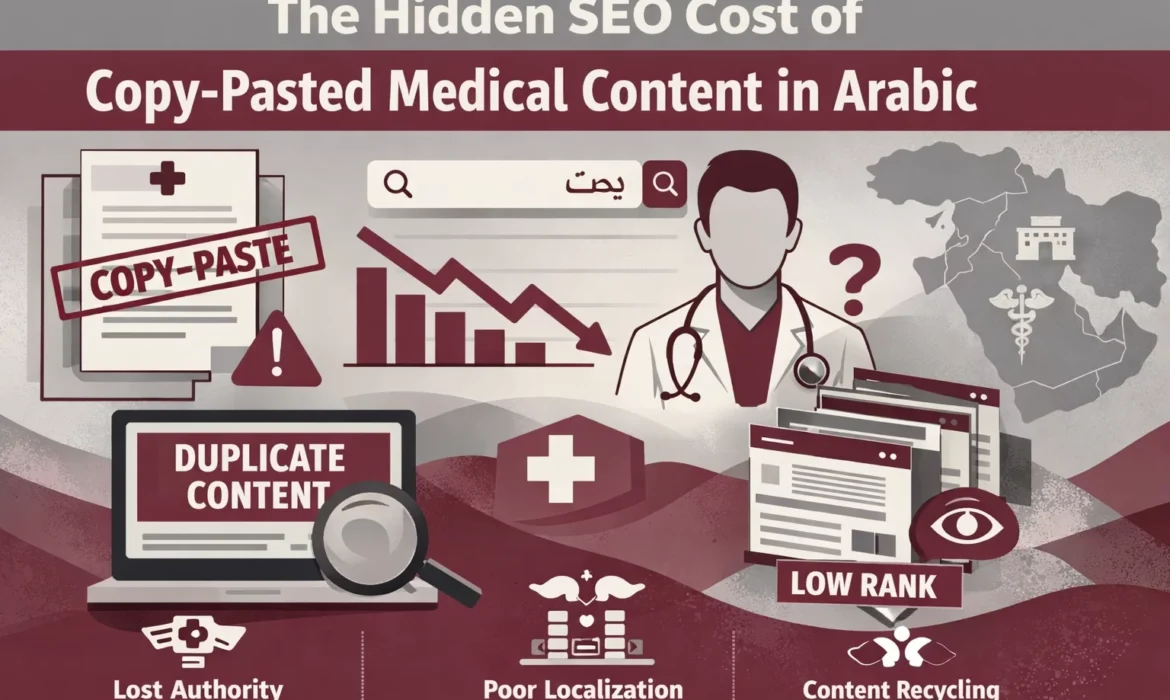
There’s a strange confidence people have around medical content. If you translate it, it should work. That’s the assumption.
I hear this a lot from clinics: “We already have the Arabic content, we translated it from English.” And I never know whether to laugh, or sigh, or just explain how badly that hurts search performance.
Because once healthcare content goes live, you’re in YMYL territory. Google doesn’t just ask “Is this readable?” It asks, “Should a human being trust this with their health?”
That’s a heavier lift, and Arabic content often doesn’t get there—not because Arabic is the problem, but because copy-paste culture is.
I’ve been auditing medical websites for clinics and hospitals across the Gulf and Levant for a while now, and there’s a pattern.
Almost every website has the same blocks of text. Same structure. Same vocabulary. Same “consult your doctor if symptoms persist” endings.
And none of it actually helps with rankings, conversions, or patient trust.
Let’s unpack why.
Translation ≠ Localization Especially in Medicine
Here’s something translators don’t always account for: medicine isn’t just language, it’s systems and pathways.
In Arabic, certain medical terms simply don’t map cleanly. Others have multiple meanings depending on country.
And then there’s the healthcare model — which is different in Saudi vs. Jordan vs. Egypt vs. UAE.
Example: English content loves the phrase “contact your primary care physician.” Most Arab countries don’t even operate on that model.
Patients jump straight to specialists. Insurance rules are different. Referral systems are different. Even the way people describe pain is different.
So when clinics ask how to write YMYL medical content, I always say: “It’s localization. Not translation. And localization isn’t just words.”
Localized content should reflect:
- local disease prevalence
- cultural concerns
- insurance and payment models
- local clinical pathways
- regional medical societies
- reading level (most medical Arabic is written like a journal article… which nobody reads)
The irony is that English content feels “cleaner” because it sits on top of a large ecosystem of guidelines, societies, and peer-reviewed work. Arabic just doesn’t have that density online.
Read more on How CTR Optimization Works Differently for Medical Websites
Lost Topical Authority: When Every Clinic Publishes the Same Article
Most medical content in Arabic follows the same recipe:
Symptoms → Causes → Diagnosis → Treatment → When to See a Doctor
It’s so uniform that if you remove the logo, you can’t tell which clinic wrote what. And Google notices that too.
Topical authority comes from:
- unique angles
- credible authors
- regional context
- case examples
- entity links (disease → doctor → procedure)
- internal linking that mimics clinical thinking
But most SEO content for clinics and hospitals is produced by freelancers who weren’t given medical notes, guidelines, or access to a doctor.
They google the condition, paraphrase WebMD, translate it, and paste it. Job done.
Except… that content doesn’t build authority. It’s just digital wallpaper. It fills a page, but nobody benefits—not patients, not Google.
Learn more on GEO, AI Summaries, and the Future of Medical Search in Arabic
Duplicate Medical Entities (AKA: Why Your Ranking Flatlines)
Here’s something nobody outside the medtech SEO world talks about: entity duplication.
Medical content isn’t just text. It’s entities:
- diseases
- organs
- specialties
- procedures
- doctors
- drugs
- hospitals
If you copy a paragraph about “Type 2 Diabetes,” you aren’t just duplicating words. You’re duplicating entity relationships.
And when 20 clinics do that, Google forms one cluster and throws everyone else out of the meaningful competition pool. Not penalized… just ignored.
One of the biggest healthcare SEO content mistakes I see is clinics saying:
“But it passed plagiarism checks, so it’s original.”
Plagiarism tools check sentences. Google checks entities. Different game.
For more info read What Google Considers ‘Medical Expertise’
How Google Detects “Content Recycling” Without Any Plagiarism Tool
Clinic managers often ask me: “Why does our content feel weak? We didn’t copy anyone.” And they’re right — sometimes there’s no copy-paste at all. But Google still sees it as recycled because the shape of the content is identical.
Markers of recycled medical content include:
- same claim order (symptoms → causes → diagnosis…)
- generic disclaimers
- zero attribution
- zero local context
- zero entity linking (disease → organ → specialty)
- missing experience signals (cases, outcomes, pathways)
- missing medical societies or guideline references
These violate multiple medical content requirements for Google, not because they are “wrong,” but because they are shallow.
Google can smell shallow from miles away.
Learn more on From Keywords to Clinical Authority: How Google Evaluates Medical Expertise in 2026
The Reality: Arabic Medical Content Has No Strong Web Corpus
This part is painful, especially as a doctor. English medical content has structure. If you need to check a fact, you go to:
- Mayo Clinic
- NHS
- Cleveland Clinic
- PubMed
There are standards. Clinical language norms. Tons of training data.
Arabic doesn’t have that ecosystem (not online, anyway), so Google is stuck. When it tries to verify Arabic claims, it often finds very little, and ends up trusting English sources instead.
So when clinics copy English structures into Arabic, they widen the gap instead of closing it.
This is why Arabic healthcare SERPs sometimes feel like outdated textbook summaries. They’re just floating out there with no support network.
Read more on Why Medical Websites in MENA Fail Google’s Trust Test
So What Should Clinics Actually Do? Without Overcomplicating
If you’re a clinic, hospital, or platform, and you want to publish medical content that actually ranks and converts, here’s the short formula:
Write like a doctor, format like a journalist, optimize like an SEO.
That means:
- real medical authors (doctors, pharmacists, dietitians)
- localized context (insurance, guidelines, prevalence)
- entity-first writing (not keyword stuffing)
- credible sources (not Pinterest health blogs)
It takes more time. It costs more. But it’s the difference between being indexed and being trusted.
Learn more on Internal Linking for Clinics: A Doctor’s Perspective on Smarter SEO
Conclusion: The Problem Isn’t Arabic. It’s Shallow Medical Content.
There’s a hidden SEO cost to copy-pasted Arabic medical content, and it rarely shows up as penalties. It shows up as absence:
- no rankings
- no authority
- no patient trust
- no conversion
- no E-E-A-T signals
Google doesn’t know what to do with medical content it cannot verify, contextualize, or attribute — and the Arabic medical web still doesn’t give it enough context to work with.
Clinics that move beyond translation and into medically-authored, localized, entity-based content will own the next decade of healthcare search in MENA.
Maps of Arabia has been doing exactly that. We don’t translate symptoms pages — we author medical knowledge for the web.
Hospitals see the difference in ranking and in patient trust. And honestly, so does Google.