

If there’s one thing that surprised me when I shifted from clinical rotations to medical SEO work, it’s how click behavior in healthcare has its own psychology.
People don’t interact with clinic websites the same way they do with SaaS or e-commerce, and honestly, thank God—because the intent is wildly different.
I remember watching GA4 dashboards during night shifts, refreshing between admissions, and realizing that someone searching “OBGYN near me open now” at 2 AM behaves nothing like someone comparing sneakers.
This is where the nuance lies: CTR optimization for medical websites isn’t about clever headlines, it’s about reducing uncertainty long enough for the patient to click.
As MoA’s resident weird hybrid of OBGYN trainee + SEO specialist, let me break down what actually moves clicks in healthcare and why typical SEO playbooks fall short.
1. Appointment CTAs vs Emergency CTAs: Two Different User Journeys
Medical sites aren’t just “choose service → buy.” They support two parallel decision models:
(A) Scheduled care (Appointment CTAs)
Think dermatology, OBGYN, dental, endocrinology. These users compare. They read. They Google. They check reviews. They compare again. CTR here improves when:
- There’s a visible doctor name or specialty in the title tag
- Insurance acceptance is clarified early (this affects clicks more than most CRO agencies realize)
- Appointment CTAs are non-pushy (“Book consultation” > “Buy”)
- Pages rank on long-tail queries like “PCOS doctor who speaks Arabic in Dubai”
This is where increasing appointment bookings SEO becomes more than just ranking—it’s about converting uncertainty.
Most hospitals never knew how many clicks they lost just by hiding consultation prices.
(B) Emergency care (Urgent CTAs)
Urgent care, pediatrics, trauma, ER-like queries. The mental model is “help now.” CTR is driven by:
- Open hours
- Location proximity
- “Call now” instead of “Book later”
- Real-time availability signals if possible
When I was doing OBGYN night float last year, I saw families search “pediatric ER open now” while panicking over a fever spike.
No one reads blog posts in that situation. They click the first credible emergency signal they see—that’s why CTR rules change dramatically for healthcare.
And here’s the kicker: most dev teams and marketing agencies don’t know the difference. That’s why clinics need the best medtech SEO agency in MENA instead of generic vendors who treat hospitals like Shopify. CTR in healthcare is medical UX, not marketing UX.
Read more on Arabic Healthcare in the Age of AI: GEO, Summaries, and the Authority Gap
2. Social Proof vs Clinical Proof (And Why Clinics Need Both)
Most industries use social proof to increase clicks—reviews, stars, testimonials—and yes, it works in healthcare, but only partially. Because patients also look for clinical proof, which SaaS websites don’t need to worry about.
Social proof = “other patients trust this doctor”
Clinical proof = “this doctor is qualified to treat my condition safely”
Examples of clinical proof signals:
- Board certifications
- Years of practice
- Fellowship programs
- Sub-specialties
- Academic affiliations
I remember the first time a clinic asked me to “just boost the reviews on Google to improve CTR.” I had to explain that a cosmetic clinic with 4.9 stars and no listed surgeon credentials is actually less clickable than a 4.5 clinic with detailed credentials. Patients know the difference, especially in YMYL categories.
These elements also feed into:
- trust signals for healthcare websites
- how medical websites convert patients
- CRO strategies for clinics
Most agencies over-optimize for reviews and social panels. But medically, clinical proof carries more CTR weight on condition-specific queries like:
“Best IVF Clinic in Dubai”
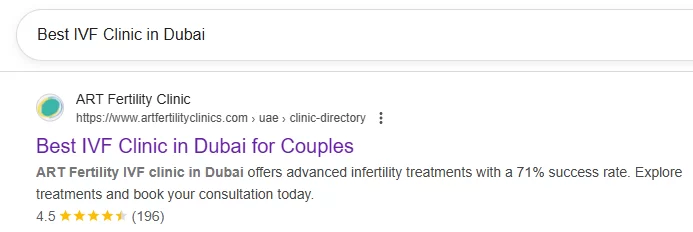
Which leads directly to the final battleground: credential placement.

Learn more on What Google Considers ‘Medical Expertise’
3. Credential Placement: The Most Underrated CTR Factor in Healthcare
Something bizarre happens when you audit enough hospital pages—you realize that credentials exist but are buried.
I’ve seen sites where:
- The doctor name isn’t in the title tag
- Their specialty isn’t in the meta description
- Their subspecialty is mentioned halfway down the page
- Their certifications are attached as a PDF
- No wonder CTR underperforms. Here’s what I’ve consistently seen outperform during audits:
Inline credentials in metadata
Patients click faster when they see:
- “Dr. X — Consultant OBGYN”
- “Board-Certified Cardiologist”
- “Fellowship Trained in Oncology”
Above-the-fold credentials on landing pages
When clinical proof sits near the appointment CTA, CTR → conversions → bookings increase. That’s the full chain that generic marketers miss.
It’s also where choosing an SEO agency with medical expertise matters because a clinician knows why “FRCOG” means something and a normal CRO specialist just… doesn’t.
For more info read From Keywords to Clinical Authority: How Google Evaluates Medical Expertise in 2026
Keywords & CTR: Where Normal SEO Fails Medical SEO
Healthcare CTR is tied to credibility, not just query match. That’s why clinics partner with medical SEO specialists instead of mass-market vendors promising “more traffic.”
The medical vertical requires:
- Compliance with YMYL standards
- Accuracy aligned with medical guidelines
- SERP behavior driven by fear, urgency, or uncertainty
CTR optimization marries all of that with SERP psychology—especially when you add entity building and geography into the mix through local seo, arabic seo, and medtech seo.
That’s why I always say: CTR in medicine is a clinical conversion problem, not a marketing one.
Why This Matters for Clinics Right Now
Because medical SERPs are being reshaped fast:
- AI summaries are reducing click volume
- Local intent queries are skyrocketing
- Insurance filters steer patient choice
- SGE introduces clinical information panel.
Clinics who adapt CTR for healthcare-specific behavior (not generic SEO advice) will book more patients—not just more impressions.
In other words: CTR → Qualified Clicks → Appointments → Retention → Revenue
And if you zoom in, improving CTR in medicine supports:
- increasing appointment bookings SEO
- CRO strategies for clinics
- how medical websites convert patients
While preserving credibility and safety.
Read more on Why Medical Websites in MENA Fail Google’s Trust Test
Final Thought (From the OBGYN + SEO side)
Between rounding, clinics, and SEO dashboards, I’ve learned that patients don’t click like consumers.
Their searches are emotional, scared, hopeful, cautious. CTR optimization in healthcare respects that reality instead of fighting it.
If the industry keeps applying SaaS SEO logic to healthcare, we’ll keep losing patients the moment they hit the SERP. If we apply medical logic, clinics start winning quietly.
And if you’re a clinic, hospital, or medtech platform thinking about growth—the agency you choose matters. Not for vanity metrics, but for patient outcomes and clinical trust.
If you’re a clinic, hospital, or medtech platform and you want CTR that actually converts into appointments—reach out to Maps of Arabia. We’re the team that understands medicine and search, not just keywords and dashboards.




[…] more about How CTR Optimization Works Differently for Medical […]