
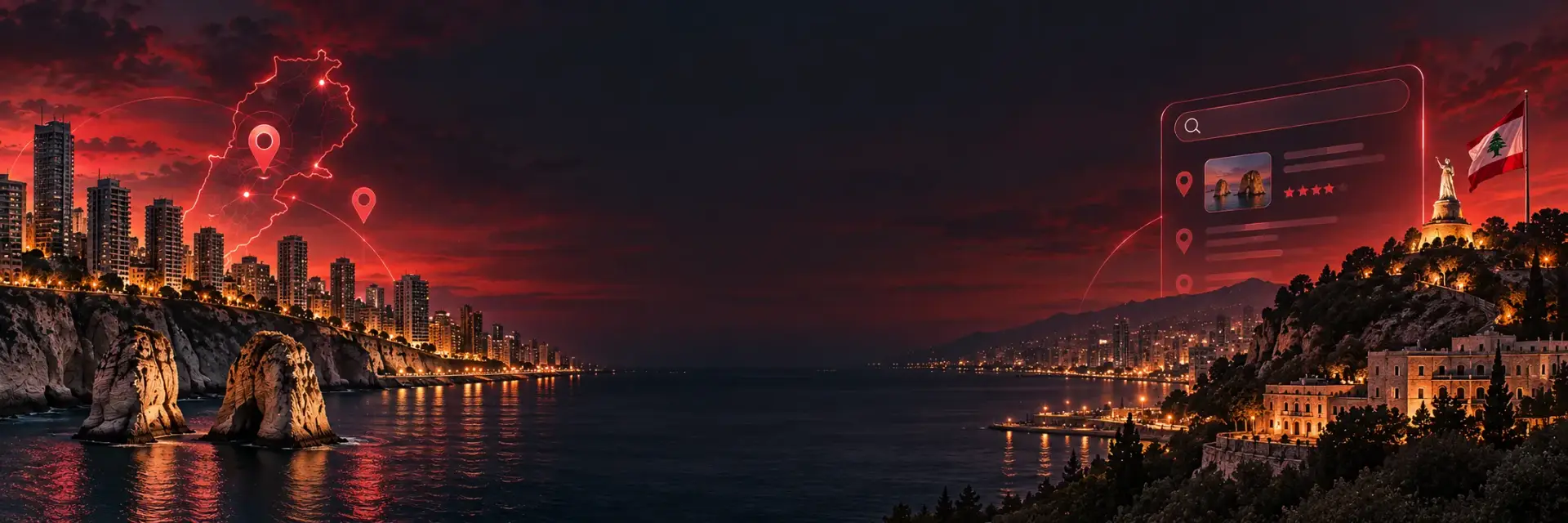
A restaurant in Beirut, a dental clinic in Tripoli, and a hotel in Jounieh may all have something in common: they want to be discovered when someone nearby searches for what they offer.
But the way customers discover them is not necessarily the same.
A person in Beirut may search by neighborhood. Someone in Zahle may think in terms of the wider Bekaa region. A customer in Jounieh may consider several nearby coastal areas before choosing where to go. In Tripoli, the city itself may be a stronger geographic reference.
Even language can change the way a search is expressed.
This raises an interesting question:
Does local search work the same way across Lebanon? or is local SEO in Beirut differs?
Not quite.
The fundamentals of being discoverable locally are broadly similar, but the geographic scale, competition, language, customer radius, and search intent can change considerably from one place to another.
Understanding that difference is more useful than treating every Lebanese city as a variation of the same search market.
Why Geography Changes the Way People Search
When people search for a local business, they rarely think about geography in purely technical terms.
They think about convenience.
They may ask:
- What is close to me?
- Which business is in my neighborhood?
- What is available in this city?
- Can I easily get there?
- Is there a better option a few towns away?
- Which business has the service I actually need?
The answers depend heavily on where the person lives and what they are looking for.
A five-kilometer journey can feel significant for one type of business and completely reasonable for another.
A person buying coffee may not want to travel across the city.
Someone looking for a specialist doctor may happily travel from one city to another.
This means there is no universal definition of a “local customer.”
The customer’s acceptable travel distance is partly determined by the service itself.
Beirut: When the Neighborhood Can Matter as Much as the City
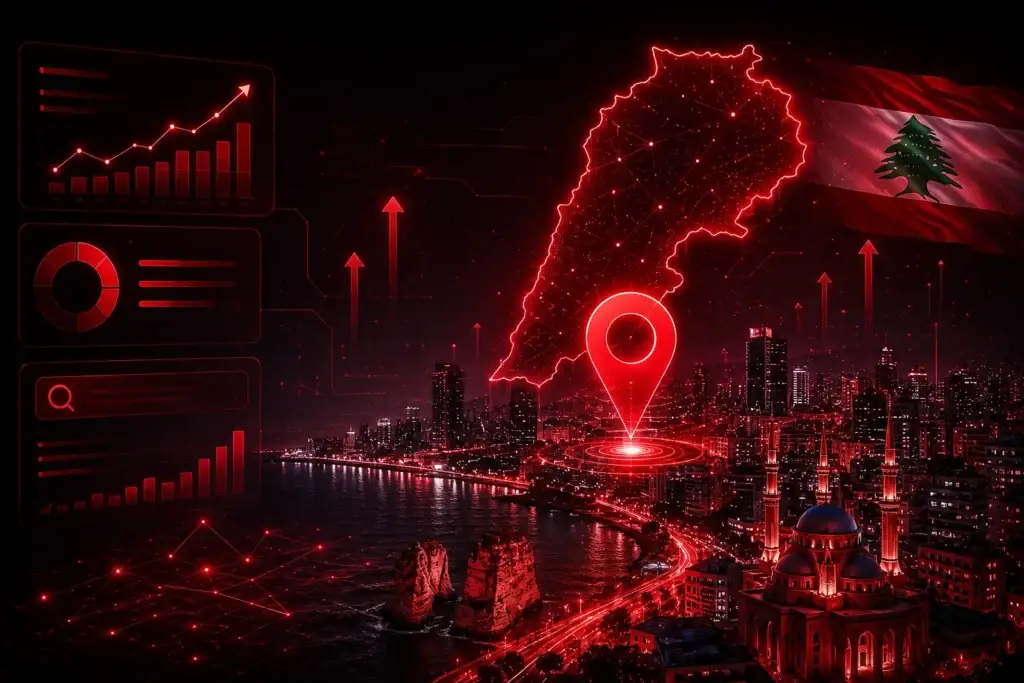
Local SEO in Beirut presents a particularly interesting local search environment because the city contains numerous recognizable neighborhoods and commercial areas within a relatively compact geographic space.
A search for:
“restaurant Beirut”
can have a very different meaning from:
“restaurant Hamra”
or:
“restaurant near Mar Mikhael.”
The city name provides broad geographic information.
The neighborhood provides something more precise.
This creates multiple layers of local intent:
Lebanon → Beirut → neighborhood → street or landmark → immediate surroundings
For some businesses, that extra geographic specificity can be extremely useful.
Consider someone searching for a hair salon.
They may not be interested in every salon across Beirut. They may want something close to their home, office, university, or evening plans.
The same principle can apply to:
- cafés
- pharmacies
- gyms
- restaurants
- beauty businesses
- convenience stores
- dental clinics
- repair services
Beirut’s density therefore creates an unusual situation:
Being in the right city may not be enough. Being relevant to the right part of the city can matter too.
Tripoli: When the City Can Become the Stronger Geographic Signal
Tripoli presents a different geographic context.
Rather than assuming that customers behave exactly like customers in Beirut, it can be more useful to consider the relationship between the city and the surrounding communities it serves.
A business may attract people searching specifically for Tripoli, while others may search using a service name without mentioning a location at all.
The important question becomes:
How far does the business’s actual customer base extend?
For a neighborhood café, that radius may be relatively small.
For a specialist healthcare provider, educational institution, professional service, or destination business, it could be considerably larger.
This means a business in Tripoli should not automatically copy a Beirut-style neighborhood strategy simply because both are Lebanese cities.
The geographic unit that matters may be different.
Sidon: When the Local Market Can Extend Beyond the Address
Sidon, or Saida, offers another useful example.
A business may have a physical address in the city while serving customers from surrounding areas.
This creates an important distinction between:
Where the business is located
and
Where its customers come from.
These are not always the same thing.
A specialist service can attract people who are willing to travel because alternatives are limited or because the service itself is worth the journey.
For a more routine purchase, however, proximity may dominate the decision.
This is why simply placing a city name on a webpage does not automatically create local relevance.
The more meaningful question is:
What geographic area does this business genuinely serve?
Zahle and the Bekaa: The Importance of the Wider Service Area
Zahle provides another interesting contrast.
The relationship between a business and its customers may extend beyond a single urban center, particularly for services that people are willing to travel for.
A business may therefore need to think about its local presence at more than one geographic level:
Zahle → surrounding communities → wider Bekaa
But there is an important limitation.
Serving customers from nearby towns does not mean that a business should create dozens of pages targeting every place name it can find.
That can easily turn useful local information into repetitive content.
A better approach is to communicate the real service area clearly and explain the information that actually matters to customers.
For example:
- Where is the business?
- Who does it serve?
- How can customers reach it?
- Does it accept customers from surrounding towns?
- What makes traveling there worthwhile?
- Which services attract customers from farther away?
The goal is to describe the actual relationship between the business and the region—not manufacture one.
Jounieh: When Nearby Cities Can Blur Together
Jounieh presents another interesting situation because coastal communities can sit relatively close to one another.
For a customer, the question may not always be:
“Which business is inside my exact city?”
It could instead be:
“Which business is easiest for me to reach?”
That distinction becomes particularly relevant when several nearby areas offer similar businesses.
A customer might compare options based on:
- travel time
- traffic
- parking
- reputation
- opening hours
- price
- quality
- availability
In other words, the boundaries shown on a map may not perfectly match the boundaries inside a customer’s mind.
People often think in terms of routes and destinations, not administrative borders.
Beirut vs. Other Cities: The Biggest Difference Is Scale
One of the clearest differences between Beirut and smaller or less densely packed markets is the scale at which local competition occurs.
In Beirut, a business can potentially compete with several alternatives within a small area.
That makes very specific geographic intent more noticeable.
In another city, the competitive landscape may be broader.
A customer might compare businesses across a larger area because there are fewer options nearby or because traveling between communities is normal for that service.
This creates two very different questions.
In a dense urban market:
“Which relevant business is closest to me?”
In a wider regional market:
“Which relevant business is worth traveling to?”
Both are local searches.
They simply represent different versions of local intent.
The Same Business Can Have a Different Customer Radius
Here’s where the comparison becomes even more important.
Imagine three businesses:
A neighborhood bakery
Customers may care heavily about convenience.
The acceptable travel distance could be small.
A specialist clinic
Customers may be willing to travel considerably farther if the service is difficult to find elsewhere.
A destination restaurant
Customers may travel across multiple neighborhoods—or even from another city—because the experience itself is part of the reason for the journey.
All three businesses could operate in Beirut.
Yet their local search markets would be completely different.
This is why business type can be just as important as city when understanding local search.
Does “Near Me” Mean the Same Thing Everywhere?
Not necessarily.
“Near me” is fundamentally a proximity-based query, but proximity is relative.
For someone in a dense part of Beirut, “near me” may mean a very small area containing several competing businesses.
For someone in a less densely populated area, the most useful result might be several kilometers away.
And for a specialist service, “near me” may still lead to a business that is farther away because relevance can outweigh pure distance.
This produces a useful principle:
Nearness is not simply distance. It is distance relative to the alternatives available to the searcher.
That is one reason local search cannot be understood through location keywords alone.
Language Adds Another Layer to the Comparison
Geography is only part of the story.
Lebanon’s multilingual environment means that users can search in Arabic, English, French, or combinations of these languages.
But language use should not be reduced to a simple city-by-city formula.
It can vary according to:
- industry
- audience
- age group
- education
- tourism
- professional context
- familiarity with a particular service
- whether the search is casual or specialized
A person searching for a local restaurant may use one language, while searching for a medical procedure or professional service in another.
The same person can even change languages between searches.
So instead of asking:
“Which language does this city use?”
a more useful question is:
“Which language does this audience naturally use for this type of search?”
Arabic Search Is Not Simply an English Search Translated
This distinction becomes especially important for Arabic-language searches.
A phrase that sounds perfectly natural in English may have several possible Arabic equivalents, and the phrase people actually type may differ from a formal translation.
Lebanese users may also combine Arabic with English terminology or use Latin characters for certain words.
For businesses serving Arabic-speaking audiences, this means useful Arabic content should reflect real language behavior, rather than simply translating every English page word for word.
The same principle applies to French.
Multilingual visibility is therefore not simply:
English keyword → Arabic translation → French translation
It is closer to:
Audience → language → terminology → intent → location
That is a much more accurate way of understanding multilingual search.
Beirut Has More Neighborhoods. Does That Mean More Location Pages?
Not automatically.
This is one of the easiest traps to fall into.
A business might discover searches involving:
- Achrafieh
- Hamra
- Verdun
- Badaro
- Ras Beirut
- Gemmayzeh
- Mar Mikhael
and conclude that it needs a separate page for every neighborhood.
But a location page is only useful when the location genuinely changes the information.
If five pages say essentially the same thing with only the neighborhood name changed, they add little value to the reader.
A genuinely useful local page should answer questions that matter to someone in that area.
For example:
How do I get there?
Does the business actually serve this area?
What services are available?
What nearby areas are covered?
Why would someone from this neighborhood choose this business?
If the page cannot answer anything beyond “we serve Hamra,” the neighborhood name may not justify an entire page.
Google Maps Changes the Decision
Local discovery is not limited to traditional search results.
When people search for businesses, Google Maps can become part of the decision-making process.
A local listing can provide information such as:
- location
- opening hours
- reviews
- photographs
- phone number
- website
- directions
- business category
This can make the customer’s journey much shorter.
Someone may not need to visit a business website at all before deciding whether it is worth considering.
The importance of this can vary by city and business type.
In a dense urban area, customers may compare several nearby businesses on a map.
In a broader service area, they may use Maps to determine whether a farther-away business is realistically accessible.
Again, the same technology supports different forms of local intent.
Reviews Can Reveal Geographic Reality
Reviews can also tell us something that business descriptions often cannot.
A customer may mention:
- coming from another town
- difficulty finding parking
- accessibility
- proximity to a landmark
- travel time
- whether the location was convenient
- why they chose the business over another option
These details reveal the real-world geography of demand.
A business may think it serves one neighborhood, while its reviews suggest that customers are regularly traveling from much farther away.
Conclusion: There Is No Single Local Search Strategy for Lebanon
Beirut may be Lebanon’s most concentrated and competitive urban market, but it should not automatically be treated as the blueprint for every other city for SEO in Lebanon.
The way people discover businesses depends on more than a city name. Neighborhood density, customer travel distance, competition, language, business type, and the size of the actual service area all influence what a local search looks like.
In Beirut, a customer may narrow a search from the city to a specific neighborhood. In Tripoli or Sidon, the relevant search area may extend across surrounding communities.
In Zahle, a business may draw customers from across the wider Bekaa, while in Jounieh, nearby coastal areas can overlap in the customer’s decision-making process.
And then there is language. Arabic, English, and French can all play a role, sometimes within the same customer’s search journey.
The bigger lesson is simple:
A business does not have one local market simply because it has one physical address.
Its real market is shaped by where its customers come from, what they are looking for, how far they are willing to travel, and how they describe that need.
That is why local visibility in Lebanon should begin with understanding people and places, rather than assuming that the same approach will work from Beirut to Tripoli, Sidon, Zahle, or Jounieh.
Because in the end, the most important location is not always where the business is.
It is where the customer is—and how they think about getting there.