

If you have spent five minutes on LinkedIn lately, you have probably seen someone announce that SEO is dead, GEO has replaced it, and your website needs an llms.txt file before lunch.
Let us all take a breath.
Google’s own guidance is much less dramatic. Its generative search experiences, including AI Overviews and AI Mode, are rooted in the same Search ranking and quality systems that SEOs already work with. Google still needs to crawl a page, index it, understand it, trust it, and consider it useful.
The interface has changed. The need to earn relevance has not.
That is the right starting point for AI overview optimization: solid SEO, adapted to the way generative search retrieves, combines, and presents information. Not a bag of shiny tricks.
Not a new acronym sold with a countdown timer.
In this guide, I will separate what Google has confirmed from what we can reasonably test, and from what currently belongs in the SEO rumor drawer.
What Are Google AI Overviews?
AI Overviews are generated summaries that appear when Google believes a synthesized response will help the searcher. Google can assemble an answer from multiple web sources and show clickable citations alongside it.
They are particularly relevant to informational, comparative, exploratory, and multi-step queries. These questions often require context, conditions, options, and follow-up paths.
This matters because AI overview optimization is not simply “winning position zero with extra steps.” A page may contribute one useful passage to an answer without ranking first for the exact wording of the original query. Google may also retrieve several pages from the same domain, or none, depending on the information needed.
What Google Officially Says About Generative Search
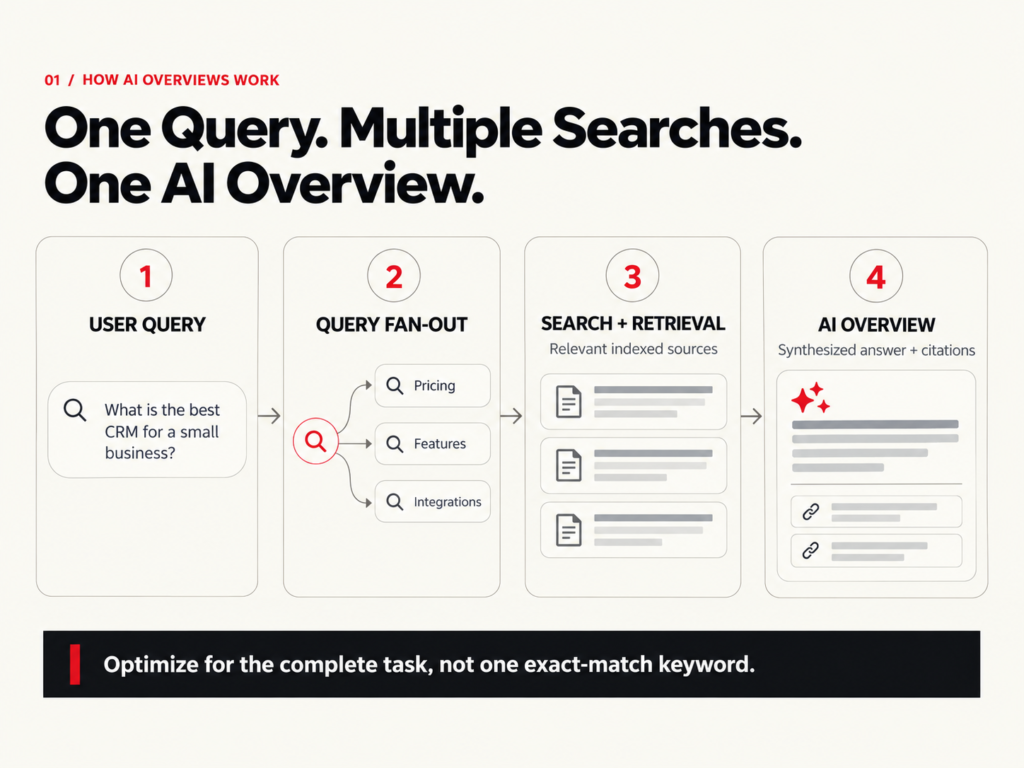
In July 2026, Google published a dedicated guide for generative AI features in Search. The core message was refreshingly unglamorous: SEO is still relevant.
Google highlights two processes:
- Retrieval-augmented generation (RAG): Google retrieves pages from its index to ground a generated response.
- Query fan-out: The model creates related subqueries to investigate different parts of the user’s need.
Google also says a page must be indexed, snippet-eligible, and included in Search’s generative AI features. It recommends unique, people-first content, clear technical structure, useful media, crawlability, and a good page experience.
So the honest definition of AI overview optimization is improving the conditions under which Google can discover, understand, retrieve, and cite the most useful parts of your content.
For the broader relationship between traditional search and generative visibility, see our Generative Engine Optimization services and Search Engine Optimization services.
Traditional Rankings vs AI Overview Citations
Traditional SEO and AI citation visibility overlap, but they are not identical.
| Traditional organic ranking | AI Overview citation |
|---|---|
| Competes for a ranked position on a results page | Competes to support part of a generated response |
| Often assessed at query and landing-page level | May be retrieved for a related fan-out subquery |
| A strong position can drive a visible click-through path | A citation may influence awareness even when it earns few clicks |
| The result usually represents one page | The answer may combine several sources and perspectives |
| Success is tracked through rankings, impressions, clicks and conversions | Success also includes citation presence, cited passages, prompt coverage and assisted conversions |
A strong organic ranking can help because Google’s AI features rely on core Search systems, but it is not a guaranteed citation ticket. AI overview optimization must also consider narrow subtopics retrieved through fan-out.
That is why I treat AI overview optimization as an extension of SEO, not a replacement for it. If a strategy ignores crawlability, search intent, authority, internal links, and conversion value, calling it “GEO” will not magically make it sophisticated.
Which Queries Are Most Likely to Trigger AI Overviews?
There is no permanent trigger list, and results vary by country, language, device, account, and phrasing. Useful opportunities tend to share a few patterns:
- The user needs an explanation rather than a single short fact.
- The query involves comparison, planning, troubleshooting, or decision support.
- Several subtopics must be considered before reaching a helpful answer.
- The user may naturally ask follow-up questions.
- Multiple credible sources can contribute different pieces of evidence.
For a MENA brand, language adds another layer. English, Modern Standard Arabic, and dialectal queries may express the same need but expose different content gaps. AI overview optimization for bilingual markets should map the underlying task, not translate one keyword list and declare victory.
For example, “best payment gateway for a UAE startup” could fan out into fees, currencies, banking integration, compliance, and sector restrictions. A generic listicle will struggle; a comparison supported by local evidence has a reason to exist.
Content Characteristics Worth AI Overview Optimization
1. Publish something the internet does not already have 400 copies of
Google explicitly recommends non-commodity content. This may include original data, first-hand experience, a tested framework, regional insight, expert analysis, real examples, or a useful point of view.
If your article rearranges the same ten tips already ranking, Google has little reason to retrieve it. A stock photo of a robot shaking hands with a human is not original research. Sorry to that robot.
Good AI overview optimization begins with an information-gain question: what can this page contribute that is specific, verifiable, and difficult to replace?
For Maps of Arabia, that may be Arabic search behavior, bilingual query differences, MENA-specific examples, regional SERP observations, or data from real SEO work. Our article on Arabic healthcare in the age of AI shows how a regional knowledge gap can become a distinct and valuable angle.
2. Answer the main question, then cover the decision behind it
A user asking “What is AI visibility?” may also need measurement, platform, citation, and business-impact answers. Query fan-out means Google may explore those questions automatically, making complete AI overview optimization more valuable than exact-match copy.
Build one coherent page that covers the necessary decision journey. Do not create 27 thin pages for tiny wording variations. Google specifically warns against producing scaled pages mainly to manipulate generative results.
In practice, AI overview optimization works better when the page has a clear primary purpose, logical supporting sections, and enough depth to resolve the user’s next sensible question.
3. Make important claims easy to verify
Support claims with dates, methodology, named experts, transparent calculations, and primary sources. If evidence comes from an internal test, label it accordingly, not as a universal ranking factor discovered during a full moon.
Clear evidence reduces ambiguity and makes content more useful and linkable.
4. Use readable structure without chopping every sentence into confetti
Descriptive headings, focused paragraphs, lists, tables, and summaries help people navigate and make passages easier to retrieve.
But Google says there is no requirement to “chunk” content into unnaturally tiny blocks. AI overview optimization does not mean turning every article into a stack of 32 two-line answers. Structure should serve the reader. If the page starts sounding like a nervous FAQ bot, we have gone too far.
5. Clarify entities and relationships
Use consistent names for companies, people, products, locations, and services. Connect authors to credible profiles, and explain relationships instead of hoping Google joins the dots.
For regional AI overview optimization, clarify markets, languages, regulatory context, and service scope, especially when a brand has several Arabic spellings or terminology varies across the GCC.
Cover Query Fan-Out Without Creating Content Clutter
In AI overview optimization, Google may turn one broad question into multiple searches, retrieve information for each, and assemble the answer.
Start with the original user task. Then map the subquestions required to complete it:
- Definition: What is the user trying to understand?
- Criteria: What factors affect the answer?
- Options: What approaches or alternatives exist?
- Evidence: What proves or challenges each option?
- Context: Does location, language, industry, audience, or regulation change the answer?
- Action: What should the user do next?
This creates depth without keyword soup and supports a rational cluster: one pillar, genuinely distinct supporting pages, and internal links that explain their relationship.
The goal of AI overview optimization is not to predict every hidden subquery. It is to build the best resource for the real problem. If that requires 90 tabs and a conspiracy board, the topic model needs less caffeine.
Technical Eligibility: The Part Nobody Can Skip
No brilliant copy can rescue a page Google cannot access or index. Before advanced AI overview optimization, check the basics:
- The URL is crawlable and returns a successful status.
- Google can render the main content.
- The page is indexable and has a valid canonical signal.
- The content is eligible to appear with a Search snippet.
- Important text is not hidden behind interactions Google cannot process reliably.
- Internal links allow discovery from relevant, indexed pages.
- Mobile usability, speed, intrusive elements, and layout do not sabotage the experience.
- Duplicate or near-duplicate URLs do not split signals unnecessarily.
- Structured data, where used, matches the visible content and follows Google’s policies.
Structured data supports eligible rich results, but Google says there is no special AI Overview schema. Adding every schema type is digital hoarding, not AI overview optimization.
Our Technical SEO Optimization services focus on the crawlability, indexing, architecture, and performance foundations that generative visibility still depends on.
Internal Links and Entity Coverage
Internal linking helps Google connect topics and moves readers toward relevant detail.
For AI overview optimization, use internal links to express meaning, not simply distribute authority like confetti:
- Link a pillar page to supporting evidence and detailed subtopics.
- Link supporting articles back to the central resource using descriptive anchors.
- Connect service pages to relevant educational content without forcing a sales pitch into every paragraph.
- Link entity pages—such as authors, locations, industries, and services, where they genuinely clarify context.
- Update older content when a new page becomes the best destination for a concept.
A good AI overview optimization cluster might connect AI search, query fan-out, visibility measurement, Arabic GEO, technical SEO, and content strategy. Give each URL a distinct job; merge or differentiate duplicates before they compete like siblings in the back seat.
Proven, Plausible, or Unsupported?
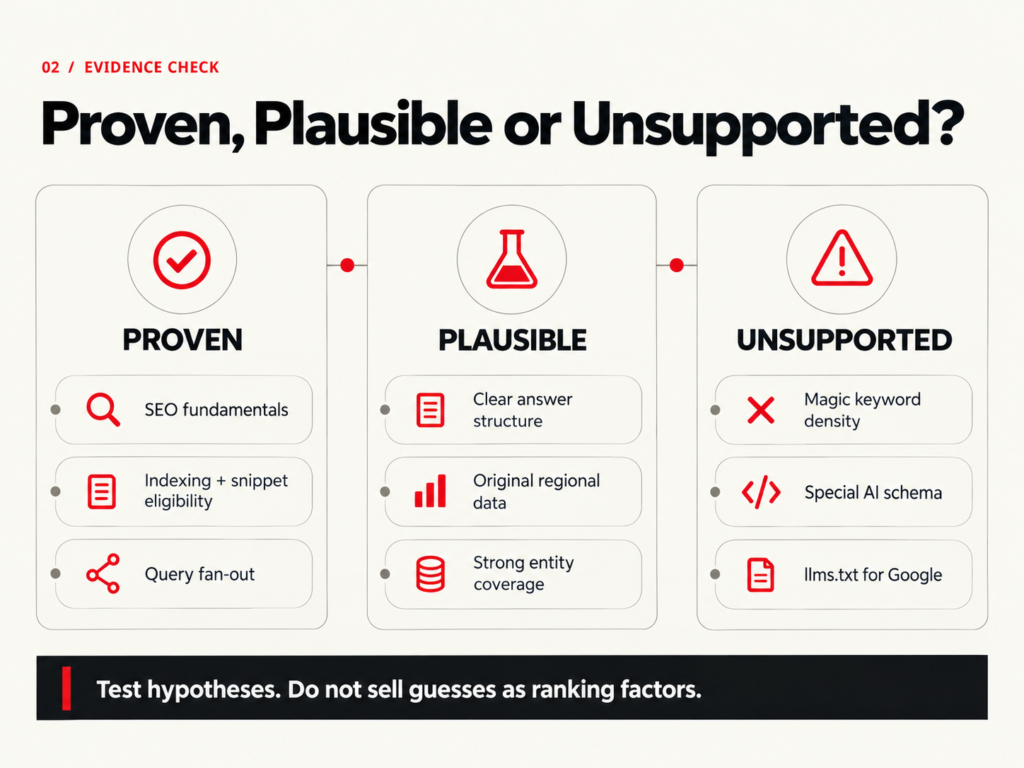
AI overview optimization requires resisting false certainty. Here is my framework:
| Claim or tactic | Status | Why |
|---|---|---|
| Strong SEO fundamentals remain relevant | Proven | Google says generative Search uses core ranking and quality systems. |
| A page must be indexed and snippet-eligible | Proven | Google lists this as an eligibility requirement. |
| Unique, people-first, non-commodity content helps | Proven guidance | Google explicitly recommends it, while serving is never guaranteed. |
| Query fan-out can retrieve pages for related subqueries | Proven | Google describes query fan-out as part of its generative process. |
| Clear headings, tables and concise answers can improve passage usability | Plausible and testable | They improve reader comprehension and retrieval clarity, but Google does not promise citations for a format. |
| Original MENA data can increase citations | Plausible and testable | Distinct evidence creates information gain and link value, but outcomes depend on quality and demand. |
| Schema directly makes a page appear in AI Overviews | Unsupported | Google says no special structured data is required for generative Search. |
| llms.txt improves Google AI Overview visibility | Unsupported | Google says it does not use the file for Search visibility. |
| Repeating the exact keyword at a magic density earns citations | Unsupported | Relevance and usefulness cannot be reduced to a percentage. |
| Buying mass “brand mentions” forces AI citations | Unsupported and risky | Google warns against inauthentic mentions and relies on anti-spam systems. |
| Breaking every article into tiny chunks is required | Unsupported | Google says there is no such requirement. |
This table is not an excuse to avoid experiments. It is a reminder to label experiments honestly. Testable hypotheses are useful. Costumes pretending to be ranking factors are not.
How to Measure AI Overview Visibility
Measurement must go beyond “we saw the brand once, screenshot attached.” Effective AI overview optimization tracks visibility and business outcomes together.
Google directs site owners to Search Console’s Generative AI performance report. Use first-party reporting as the foundation, then add controlled observation.
Track:
- Pages and queries receiving generative AI impressions.
- Clicks and click-through behavior over time.
- Landing pages gaining or losing visibility.
- Countries, devices, and language patterns.
- Citation presence for a defined, repeatable query set.
- Which passage, claim, table, or asset is cited.
- Competitor citation share for the same topic group.
- Assisted conversions, leads, sign-ups, or revenue from organic journeys.
- Changes after meaningful content or technical updates.
Record the date, location, language, device, account state, and prompt. For AI overview optimization, one manual search is an anecdote, not a dashboard.
Separate visibility from value. A broad citation may create awareness; a commercial comparison may create a lead. Both matter, but they are not the same outcome.
Common AI Overview Optimization Myths
“We need to replace SEO with GEO”
Google’s position is direct: AI overview optimization is still SEO. GEO can describe broader work across answer systems, but it does not cancel technical SEO, content quality, or authority.
“There is a secret word count for AI citations”
There is no ideal page length. A concise page can be excellent; a detailed guide can be excellent. AI overview optimization means giving the task the depth it needs, then stopping. Yes, even SEOs are allowed to stop writing.
“We need an llms.txt file for Google”
Google says it ignores llms.txt for Search visibility. Other systems may choose to use it, but it is not a special pass into Google AI Overviews.
“Schema is the new citation button”
No. Valid structured data can support your wider search presence, but Google does not require a special AI schema and does not promise that markup will produce a citation.
“If we rank first, Google must cite us”
Traditional rankings matter because the same core systems support retrieval, but an AI Overview may need different sources for different subquestions. The better question is whether your page contributes the clearest, strongest evidence for a part of the answer.
A Practical AI Overview Optimization Checklist
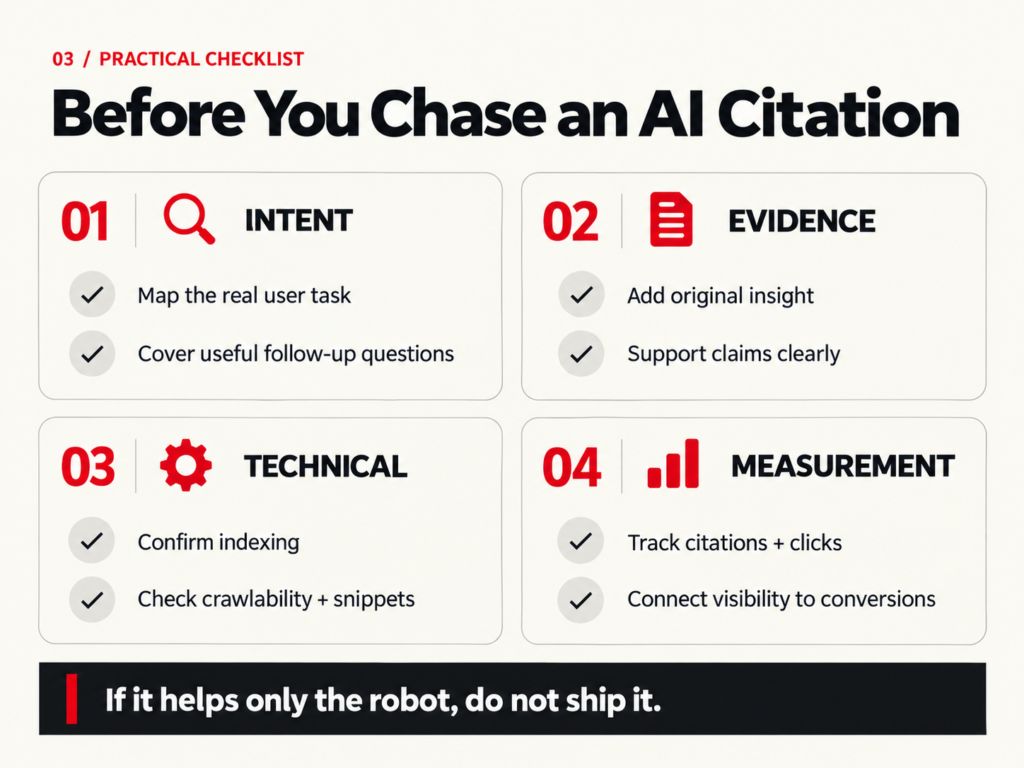
Use this checklist before publishing or refreshing a priority page:
Strategy and intent
- Define the real user task, not just the target keyword.
- Identify the comparisons, conditions, and next questions that complete the task.
- Review the live SERP and note whether AI Overviews appear for relevant query variants.
- Decide what original value your page will contribute.
Content and evidence
- Put a clear answer near the beginning without giving away an empty summary.
- Add first-hand expertise, original data, regional context, or a defensible point of view.
- Support factual claims and date anything that may change.
- Use headings, paragraphs, lists, tables, images, and video where they help the reader.
- Cover relevant entities and explain their relationships naturally.
- Remove generic padding that an AI system—or an exhausted intern—could produce in seconds.
Technical and architecture
- Confirm crawlability, indexability, canonicalization, rendering, and snippet eligibility.
- Check mobile experience and page performance.
- Add accurate structured data only where it serves a supported search feature.
- Link from relevant authoritative pages and back to the appropriate pillar.
- Resolve duplicate intent and cannibalization.
Measurement
- Establish a baseline before making changes.
- Track Search Console’s generative AI performance data.
- Monitor a stable query set without treating manual checks as absolute truth.
- Record citations, clicks, landing pages, conversions, and competitor movement.
- Review what changed, form a hypothesis, and test the next improvement.
AI overview optimization should improve the page even if an AI Overview never appears. If the work helps only a hypothetical robot and makes the page worse for people, do not ship it.
Where Maps of Arabia Fits In
For MENA brands, generative visibility is a language, entity, authority, and data problem. Arabic content is often thinner, terminology varies, and bilingual sites divide information across disconnected architectures.
At Maps of Arabia, we combine technical SEO, bilingual content strategy, entity development, internal links, and generative visibility measurement. Our AI overview optimization starts with confirmed guidance, tests plausible ideas, and avoids unsupported theatre.
That may involve repairing indexation, building a bilingual cluster, turning expertise into evidence, strengthening local entities, or measuring qualified outcomes instead of vanity mentions.
If your brand needs visibility in both traditional and AI-generated search, explore our GEO services, Arabic SEO services, or request a website SEO audit.
Final Thoughts
AI Overviews changed how Google presents answers, but not the laws of useful search. Google still needs accessible pages, trustworthy evidence, and a reason to choose your contribution.
The best AI overview optimization strategy is therefore less glamorous, and more valuable, than most hacks: build technically sound pages, publish something original, cover the complete user task, connect your entities clearly, and measure whether visibility creates business impact.
Do that consistently and you are not merely chasing citations. You are building the kind of search presence that can survive the next interface change too.