
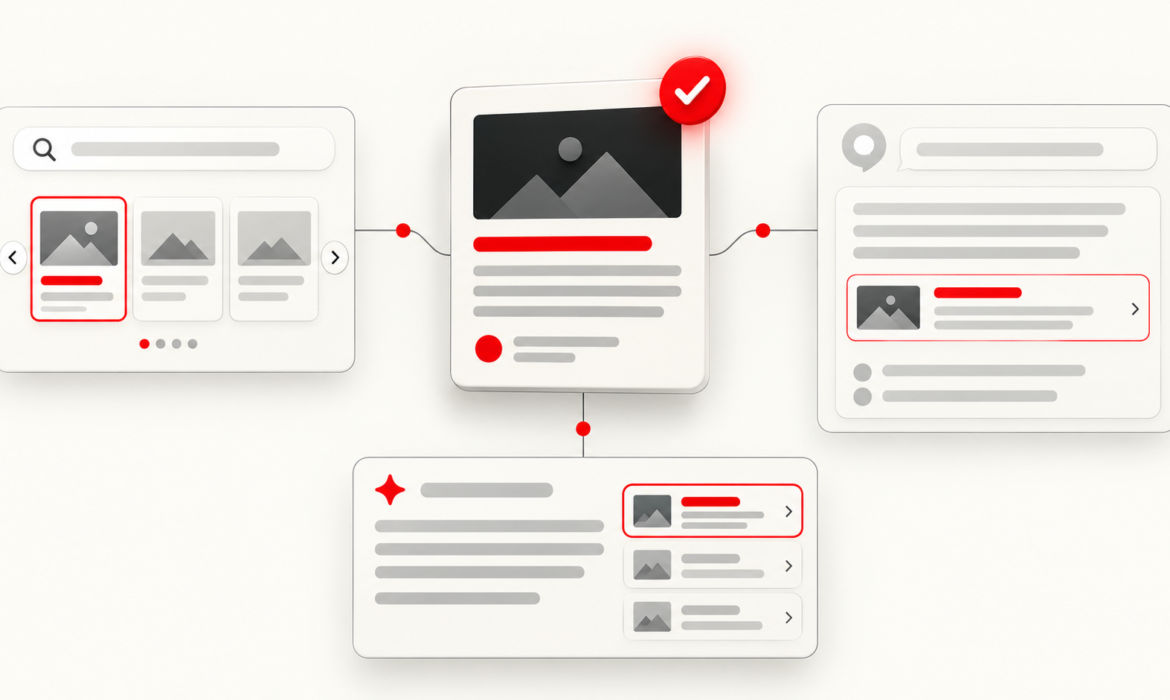
Google has given readers something SEOs have wanted for years: a visible way to say, “Yes, I trust this website. Please show me more of it.”
Preferred Sources allows signed-in users to select publications they value. Google can then surface those sites more often in Top Stories and highlight their links with a “Preferred” badge in AI Mode and AI Overviews.
For publishers, newsrooms, industry websites and brands that publish fresh editorial content, this creates an audience signal worth acting on.
But let us be precise.
Google preferred sources SEO is not a secret ranking factor, a replacement for quality journalism, or a button that teleports every article to the top of Google.
It is a reader-controlled personalization feature. That distinction matters, especially before someone sells a “Preferred Sources domination package” with twelve mysterious deliverables and one very confident dashboard.
Here is what Google confirmed, what publishers can implement and what it means for search.
What Are Google Preferred Sources?
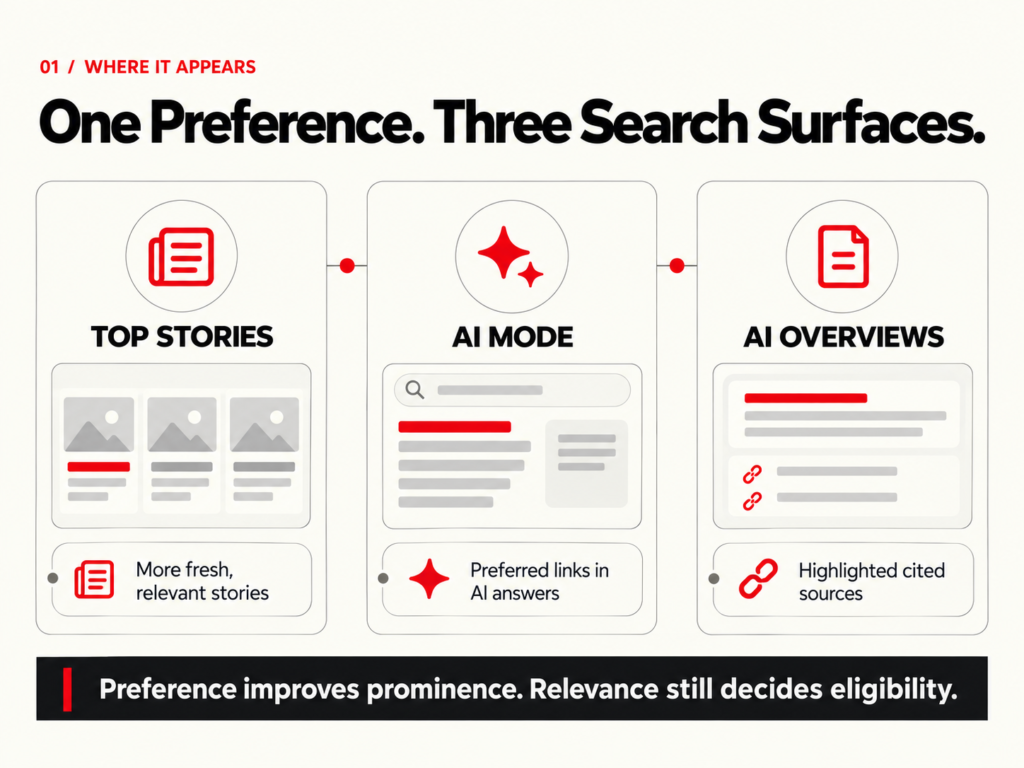
Preferred Sources is a personalization feature that lets users choose publications they want to see more frequently. Fresh, relevant stories from those sites may appear more often in Top Stories, while their links may carry a “Preferred” badge in AI Mode and AI Overviews.
This is the basic google preferred sources SEO equation:
- A website publishes fresh content.
- A reader selects the domain as a preferred source.
- Google continues evaluating relevance and quality for each query.
- When appropriate, that source may receive greater prominence or a Preferred label for that specific user.
The user is choosing a source—not rewriting Google’s entire ranking system. Relevance, freshness, quality, eligibility and the normal Search systems still apply.
Google reported in May 2026 that users had selected more than 345,000 unique sources and were twice as likely to click through to a Preferred Source. It does not promise the same lift for every site, but the preference is not merely decorative.
Where Do Preferred Sources Appear?
Top Stories
Preferred Sources is globally available for Top Stories in every language where Google Search is available. When Google detects a news-oriented query and displays Top Stories, users may see more fresh, relevant content from the publishers they selected.
For google preferred sources SEO, this makes publishing cadence important. A reader may love your site, but yesterday’s excellent article cannot cover today’s developing story unless it is still relevant and updated.
AI Mode
In AI Mode, Google can highlight preferred links inside AI-generated responses, giving publishers a recognizable signal where ordinary links may blend together.
AI Overviews
Preferred links can also appear in AI Overviews. The feature does not force Google to cite a chosen site, but when that source is useful to the answer, the Preferred badge can help it stand out.
This is where google preferred sources SEO overlaps with Generative Engine Optimization services: publishers need content that is technically accessible, clearly attributable, relevant to the topic and strong enough to support an AI-generated answer.
Who Is Eligible?
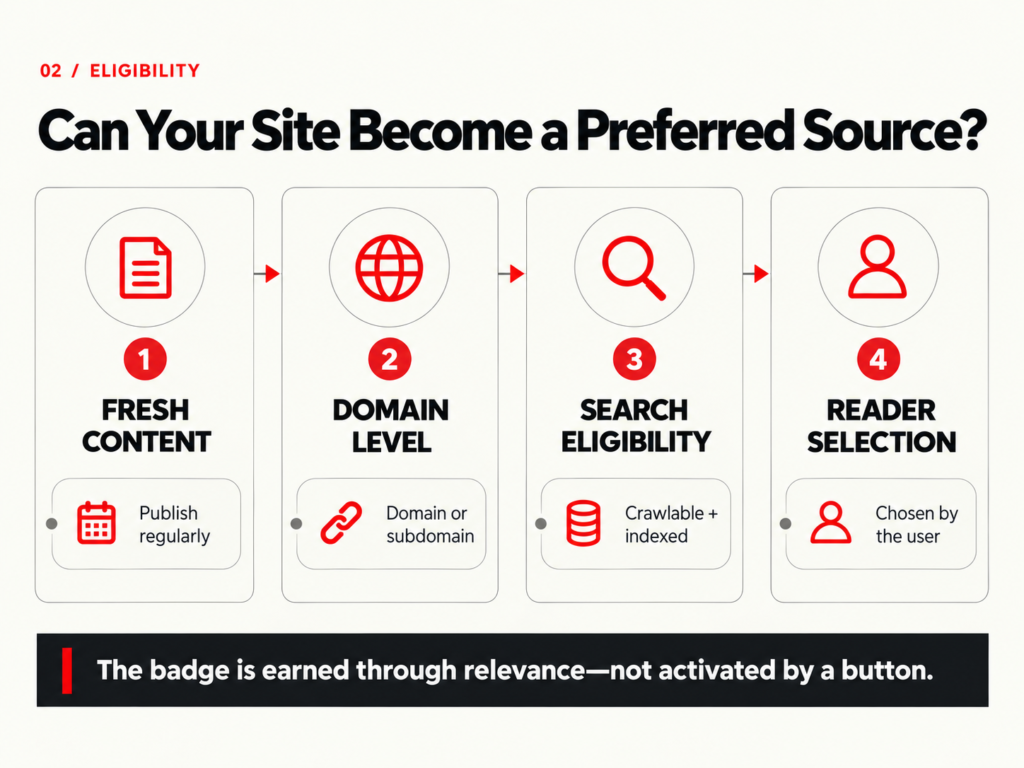
Google says any website that publishes fresh content may be eligible. In practice, publishers should understand four important conditions:
- The site needs to appear in Google’s source preferences tool.
- Only domains and subdomains can be selected. A folder such as example.com/blog/ cannot be chosen separately.
- Sites that are not updated regularly may not be available.
- To appear as preferred inside AI Mode and AI Overviews, the site must be included in Search’s generative AI features in Search Console.
So google preferred sources SEO is not restricted to giant news organizations. A specialist industry publication, company newsroom, research platform or expert-led brand may qualify if it consistently publishes fresh material.
If editorial content sits in a subfolder, users select the whole domain; a dedicated subdomain may be selected separately.
This is not a reason to migrate tomorrow morning—please put the redirect spreadsheet down, but it is a real google preferred sources SEO architecture consideration.
How Readers Select a Preferred Source
Users can select publications through Search personalization settings or from the Top Stories interface. The preference applies across Top Stories, AI Mode and AI Overviews and persists where the user is signed in.
Publishers cannot select themselves on a reader’s behalf. They can only make google preferred sources SEO discoverable through Google’s official button or source-preferences link.
This turns google preferred sources SEO into part search strategy and part audience relationship. You are not convincing an anonymous algorithm alone; you are giving real readers a reason to keep your publication close.
What Publishers Can Do Right Now
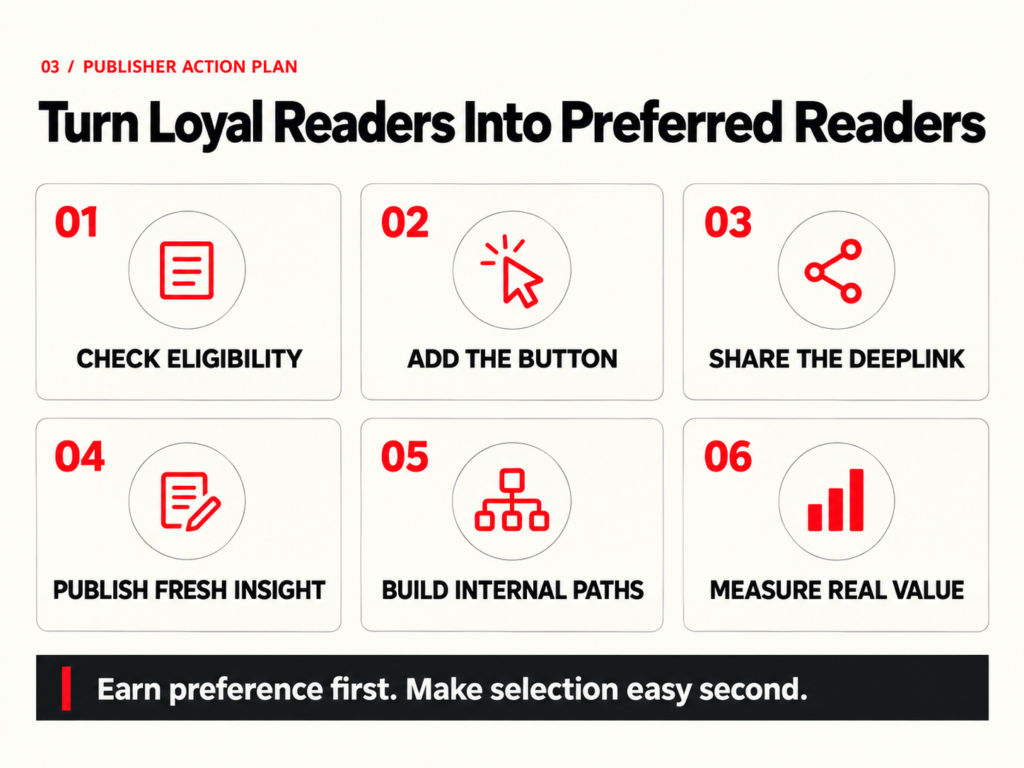
1. Confirm that your domain is available
Search for your domain in Google’s source preferences tool. If it does not appear, first check whether the site publishes genuinely fresh content and whether Google can crawl and index that content properly.
A technical review should cover status codes, canonicals, indexation, renderability, internal discovery, article dates and duplicated URLs. Our Website SEO Audit service helps prioritize these issues before promotional work begins.
2. Add Google’s official selection button
Google recommends its standard JavaScript implementation, which renders a localized button and supports light or dark themes and language overrides.
If the CMS cannot support the button, Google documents a deeplink that opens the preference tool with the domain ready to select.
For most sites, the best placements are:
- Beside the newsletter subscription prompt.
- At the end of strong editorial articles.
- On the publication or insights landing page.
- Inside a returning-reader module.
Do not place it in seven pop-ups, a sticky banner and the cookie notice simultaneously. Google preferred sources SEO should build loyalty, not test how quickly a reader can locate the back button.
3. Promote the option to existing audiences
Google says the deeplink may be shared in social posts, newsletters and promotions. Start with existing readers: “Read us regularly? Add Maps of Arabia as a Preferred Source on Google.” Explain their benefit, not your SEO target.
This also fits a wider SEO content strategy: strong content earns an audience, distribution brings that audience back, and preference gives loyal readers another route to find it.
4. Publish fresh content that deserves preference
A button cannot compensate for a site that posts twice a year or rewrites yesterday’s announcement. Sustainable google preferred sources SEO needs a recognizable editorial promise.
That may include:
- Fast, accurate coverage of material industry changes.
- Original reporting or research.
- Expert interpretation rather than press-release paraphrasing.
- Clear authorship and publication dates.
- Meaningful updates when facts change.
- Regional or Arabic-language context competitors overlook.
Our guide to improving content ranking mechanisms covers the familiar foundations: relevance, authority, freshness, language and location still shape whether content is useful for a search.
5. Build the right internal path
Link timely updates to evergreen explainers, topic hubs, services and related reporting. This supports readers and helps Google understand the publication’s subject coverage.
For google preferred sources SEO, internal linking also turns a temporary traffic moment into a longer relationship. Someone who discovers one timely article should be able to find your best analysis without conducting an archaeological dig through the blog archive.
If your publication serves Arabic and English audiences, research both journeys separately. Our article on how to optimize for search intent explains why translating words is not the same as matching meaning.
What Preferred Sources Does Not Guarantee
Let us remove the glitter before it enters the strategy deck.
Google preferred sources SEO does not guarantee:
- A number-one organic ranking.
- Inclusion in every Top Stories result.
- A citation in every AI Overview or AI Mode answer.
- Visibility to users who have not selected your source.
- Eligibility for stale, blocked or low-quality content.
- That a promotional button will improve rankings by itself.
- Access to a public list of everyone who selected your site.
Google says preferred content is more likely to appear. It must still be fresh, relevant and suitable for the query—and eligible for generative Search when shown in AI experiences.
The badge is a personalization signal, not a royal title granted forever.
The SEO Implications for Publishers and Brands
First-party audience loyalty now influences Search presentation
Subscribers, followers and returning readers can now express preference inside Google Search. Google preferred sources SEO therefore belongs across SEO, editorial, product, CRM and social—not in a silo guarded by a spreadsheet.
Brand recognition may improve click confidence
The badge helps familiar sources stand out, suggesting trust can affect selection after google preferred sources SEO visibility is earned.
Freshness becomes commercially useful beyond newsrooms
Brands publishing timely research, analysis or regulatory updates have an opportunity. Google preferred sources SEO does not require pretending every company blog is a newspaper; it requires becoming a source readers want more from.
For MENA businesses, this could be especially valuable where strong Arabic reporting and specialist analysis remain limited.
Our Arabic SEO services connect language-specific search demand with content built for regional audiences—not English articles wearing an Arabic moustache.
SEO measurement needs a loyalty layer
Google has not announced a filter revealing selection counts or isolating Preferred traffic. Measure observable google preferred sources SEO outcomes responsibly:
- Button or deeplink clicks and returning organic users.
- Newsletter and social engagement.
- Top Stories visibility for priority topics.
- AI Mode and AI Overview citations where measurable.
- Editorial engagement and conversions.
Treat correlation carefully. A traffic lift after launching a badge campaign does not prove the badge caused every visit: baseline first, implementation second, wild victory post never.
Google Preferred Sources SEO Checklist
Use this implementation and marketing checklist:
- Confirm your domain or subdomain appears in the source preferences tool.
- Verify crawling, indexing, canonicals and article-date accuracy.
- Check generative AI feature inclusion in Search Console.
- Add Google’s standard Preferred Sources button where possible.
- Use the approved deeplink when JavaScript implementation is unavailable.
- Explain the reader’s benefit in newsletters and social posts.
- Publish fresh, original and clearly attributed content consistently.
- Strengthen internal links between timely stories and evergreen resources.
- Track button interactions, returning users, Search visibility and conversions.
- Review the feature regularly because Google is actively expanding it.
Final Thoughts
Preferred Sources lets loyal readers carry their preference into Top Stories, AI Mode and AI Overviews. The opportunity is to earn that preference, simplify selection and publish material worth returning to. The implementation is easy; the editorial promise is the difficult, and important, part.
At Maps of Arabia, we approach google preferred sources SEO as part of an integrated search strategy: technical eligibility, original content, Arabic and English audience development, AI visibility and business measurement. Explore our Search Engine Optimization services or GEO services if your brand needs a practical plan for traditional and AI-driven Search.