
Ask Google the same commercial question in Arabic and English and you might expect two versions of the same answer.
That would be wonderfully tidy. Search, unfortunately, has never been hired for its tidiness.
The two queries can trigger different AI Overviews, retrieve different pages, cite different domains and even present different companies as the strongest options. This is why arabic vs english ai overviews is not a translation question. It is a retrieval, relevance and evidence question.
For brands across Saudi Arabia, the UAE, Qatar, Jordan and the wider MENA region, that difference has direct consequences. A company may be highly visible in English AI results yet practically invisible in Arabic. Another may appear in Arabic because it has useful local content, while losing the English comparison to global directories and international publishers.
As an SEO specialist, I would not diagnose that with “we need more Arabic keywords.” We need to understand which source ecosystem Google is searching in each language—and whether our brand has earned a place in both.
The Short Answer: Arabic and English AI Overviews Do Not Use Identical Source Pools
Google says AI Overviews use its core Search systems, retrieval-augmented generation and query fan-out to find relevant information from the web. Google has also expanded AI Overviews across MENA and supports Arabic globally.
That does not mean an Arabic query is translated into English, answered from the English web and translated back. Google can retrieve different documents based on the language, wording, location, intent and information available.
In practice, arabic vs english ai overviews may differ across:
- Whether an AI Overview appears at all.
- The domains and individual pages cited.
- The language of cited sources.
- The brands, products or providers mentioned.
- The balance between local and international evidence.
- The depth, confidence and specificity of the answer.
- The follow-up questions Google anticipates.
The interface may look familiar in both languages, but the evidence underneath it can be a different neighbourhood entirely.
Arabic vs English AI Overviews: A Side-by-Side Comparison
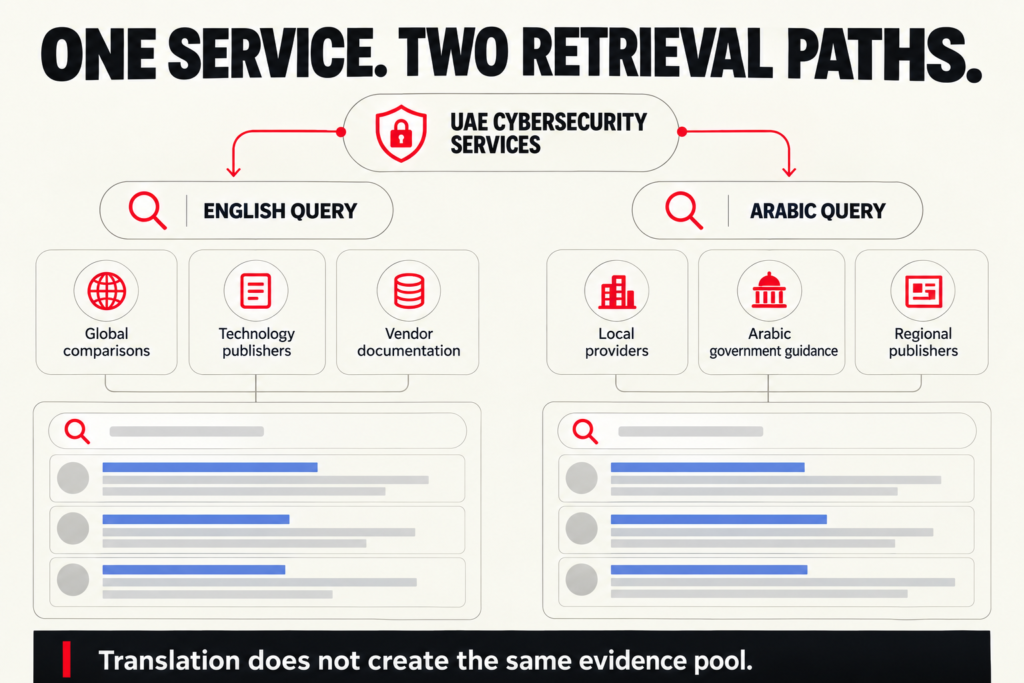
| Comparison area | English AI Overviews | Arabic AI Overviews |
|---|---|---|
| Available content pool | Larger and more mature across most industries | Smaller and uneven across industries and countries |
| Common source types | Publishers, brand sites, forums, directories, research and comparison pages | Brand-owned pages, government sources, local publishers and selected Arabic authorities |
| Third-party comparison ecosystem | Often well developed | Frequently thin or absent |
| Language variation | Regional wording exists, but standardization is relatively high | MSA, dialects, transliteration and mixed Arabic-English terminology coexist |
| Entity consistency | Usually supported by larger linked datasets | Names and categories may be written several ways |
| Local context | Can favor global or English-language regional sources | Can reward genuinely localized Arabic evidence |
| Main risk | High competition and crowded citation sources | Thin content, translation errors and missing entities |
This table describes common conditions, not an eternal ranking law. Arabic vs english ai overviews are volatile. Results can change by query wording, country, device, account state and date. Anyone promising a permanent citation after checking one screenshot is selling weather as architecture.
What Early Citation Research Suggests
Public bilingual testing is still limited, so every dataset needs a methodology label attached to it.
One August 2026 audit tested 16 matched commercial prompts from Egypt—eight Arabic/English pairs. It recorded 44 Arabic citations across eight AI Overviews and 43 English citations across six. In that small sample, vendor-owned pages represented 91% of Arabic citations versus 67% of English citations. English results included directories and third-party ranking pages; the Arabic results included none.
That is interesting, but it is not permission to announce that Arabic AI Overviews “never cite directories.” The sample covered one country, one day and a limited commercial prompt set. It provides a hypothesis worth testing across more markets and sectors, not a stone tablet from Mount Algorithm.
The useful signal for arabic vs english ai overviews is this: English searches may have a richer independent comparison ecosystem, while Arabic retrieval may lean more heavily on the brands and institutions that publish usable Arabic information directly.
This aligns with a wider problem we have discussed in Arabic healthcare and the AI authority gap: when authoritative Arabic evidence is scarce, generative search cannot cite knowledge that was never published.
Why the Citation Sources Change by Language
1. The English web contains more mature comparison layers
For many commercial topics, English search can retrieve editorial reviews, industry publications, directories, forums, research reports and vendor documentation. These sources help Google compare options and support claims from several angles.
The equivalent Arabic ecosystem may contain brand pages and general articles but fewer independent comparisons. In arabic vs english ai overviews, this can change not only the citations but the type of answer Google can construct.
If nobody has published a credible Arabic comparison of payment gateways, fertility platforms or logistics providers, Google has fewer independent sources to retrieve. It may cite provider pages, use English evidence, return a shallow answer or skip the AI Overview.
2. Arabic is not one neat keyword list
Arabic search includes Modern Standard Arabic, local dialect, English product names, transliterated brand names and mixed-language queries. One service may have several legitimate Arabic labels across the GCC.
Google introduced Arabic AI Mode using Modern Standard Arabic, but real users do not submit every query in formal newsroom language. They search naturally: sometimes formal, sometimes dialectal, and sometimes with an English noun parked in the middle like it pays rent.
That makes arabic vs english ai overviews sensitive to wording. An Arabic query written in MSA may retrieve a different evidence set from a Gulf dialect query or a hybrid Arabic-English query.
Our guide to Arabic search intent explains why translating a keyword does not reproduce the same user need.
3. Entity names are less consistent in Arabic
A brand may appear in Latin script, Arabic script and several transliterations. Locations and product categories also vary. If those forms are not connected clearly across the site and wider web, Google has more work to do when determining whether two mentions refer to the same entity.
In arabic vs english ai overviews, the English entity may have a long, consistent digital history while the Arabic version is scattered across spelling variants, thin profiles and translated pages.
This does not mean repeating every spelling fifty times. It means establishing a clear primary Arabic name, using reasonable variants where readers use them, and connecting the brand to its services, locations, authors and evidence consistently.
4. Local relevance changes the retrieval task
“Best accounting software” and “أفضل برنامج محاسبة للشركات في السعودية” are not identical searches wearing different outfits. The Arabic query introduces language and may imply local tax, currency, invoicing and support needs.
Strong arabic vs english ai overviews research therefore compares intent, not literal strings. The Arabic query should reflect how an Arabic-speaking user frames the task; the English query should reflect the equivalent English-speaking journey in the same market.
That distinction is central to our Arabic SEO services: the strategy begins with real Arabic demand, not a translated English spreadsheet.
5. Source quality can vary by sector
Government, health and financial topics may have strong Arabic institutional sources. Technical SaaS or niche B2B categories may rely heavily on English documentation. Travel, food and local services may have rich Arabic social discussion but inconsistent indexable editorial coverage.
There is no universal Arabic citation profile. Arabic vs english ai overviews must be tested by topic, market and intent cluster.
A Worked MENA Example
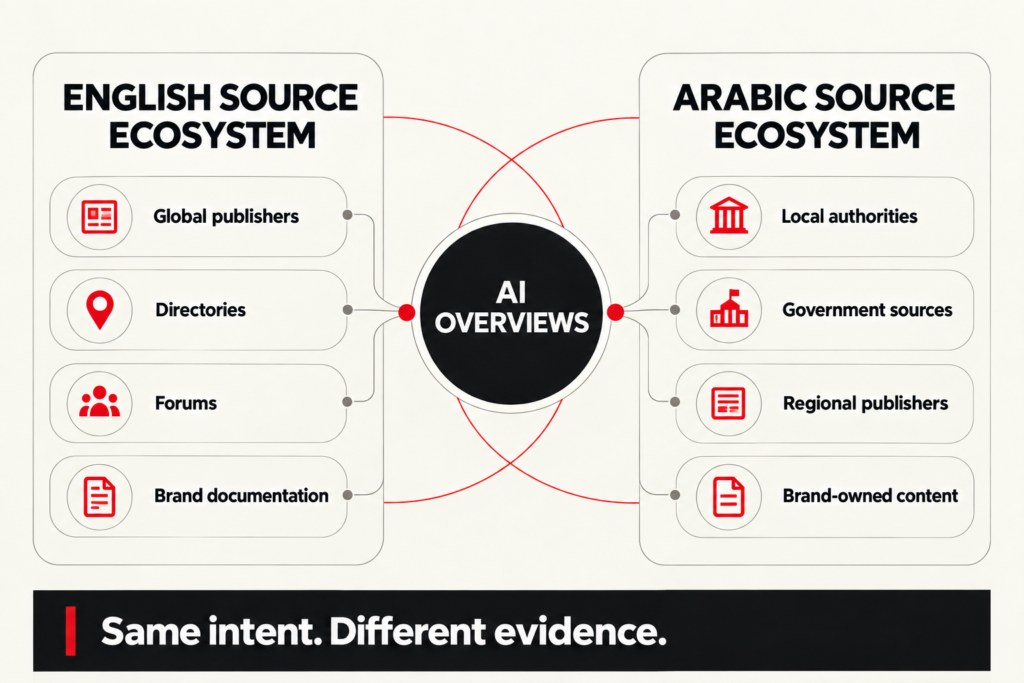
Imagine a cybersecurity company targeting the UAE.
The English query might be:
best managed cybersecurity services for UAE SMEs
Google can fan that query out into compliance, service scope, certifications, threat monitoring, UAE presence, pricing and provider comparisons. English citations might include consultancy directories, vendor pages, technology publishers and official regulatory sources.
The equivalent Arabic journey might be:
أفضل شركة أمن سيبراني للشركات الصغيرة في الإمارات
The Arabic fan-out may still investigate compliance and provider capability, but the available Arabic evidence could be much thinner. Google may cite local provider pages, Arabic government guidance and a small number of regional publishers. The companies named may not match the English response.
This arabic vs english ai overviews gap creates two separate jobs:
- Build a competitive English presence across owned and third-party sources.
- Publish original Arabic evidence that covers local questions in the language users actually search.
Copying the English service page into Arabic will not create an Arabic comparison ecosystem. It will create one translated service page. The internet has survived worse, but our citation chances have not improved much.
How to Test Arabic vs English AI Overviews Properly
A useful comparison needs more discipline than opening two tabs and becoming emotionally attached to the result.
Build matched intent pairs
Create Arabic and English prompts that express the same user task in the same market. Avoid robotic literal translations. Include informational, comparison, commercial and local prompts.
For arabic vs english ai overviews, equivalence of intent matters more than equivalence of wording.
Control the test conditions
Treat arabic vs english ai overviews as a controlled comparison, not a casual browser tour.
Record:
- Country and city where relevant.
- Date and time.
- Device and browser.
- Signed-in or signed-out state.
- Exact query wording.
- Whether an AI Overview appeared.
Capture every cited source
For each result, record the cited URL, domain, source language, page type, brand ownership and whether the source is local, regional or global.
This turns arabic vs english ai overviews from screenshots into a dataset your team can revisit.
Compare entities as well as citations
Track which brands, products, experts and institutions are mentioned. Arabic vs english ai overviews can cite different URLs while still recommending similar entities—or cite similar sources while reaching different conclusions.
Repeat the test
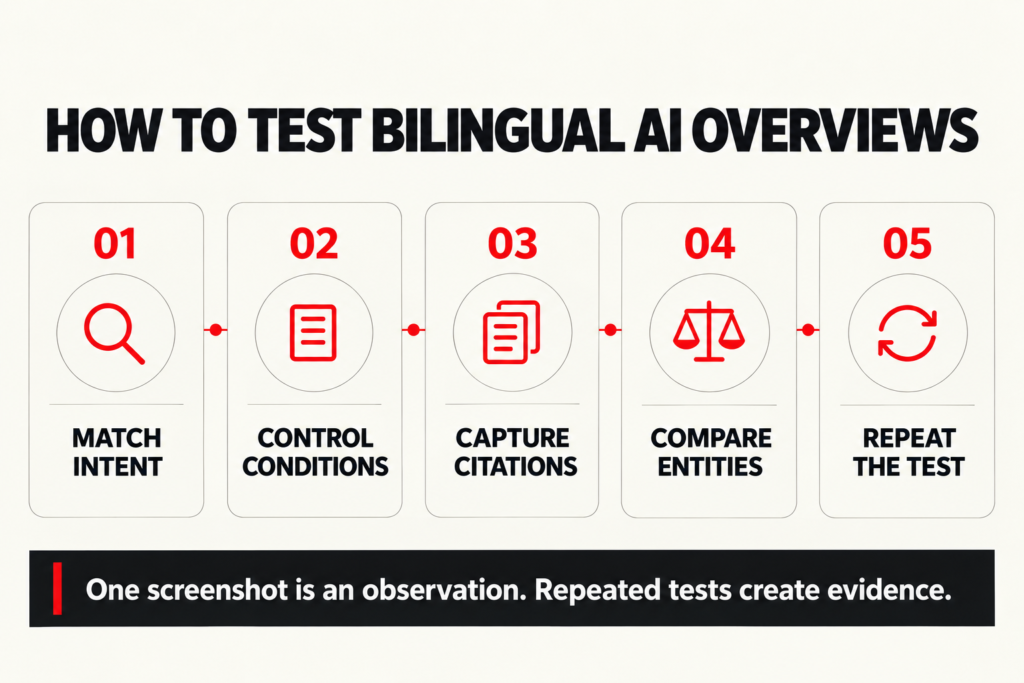
AI answers change. Run the same prompt set across several dates before declaring a pattern. Separate stable findings from one-day observations.
Repeated arabic vs english ai overviews tests reveal patterns that a single search cannot.
A quarterly arabic vs english ai overviews review also helps content, PR and product teams see which evidence gaps are shrinking—and which still need attention next.
This is also why our AI Overview optimization framework emphasizes measurement and documented experiments rather than magical formatting rules.
What MENA Brands Should Optimize
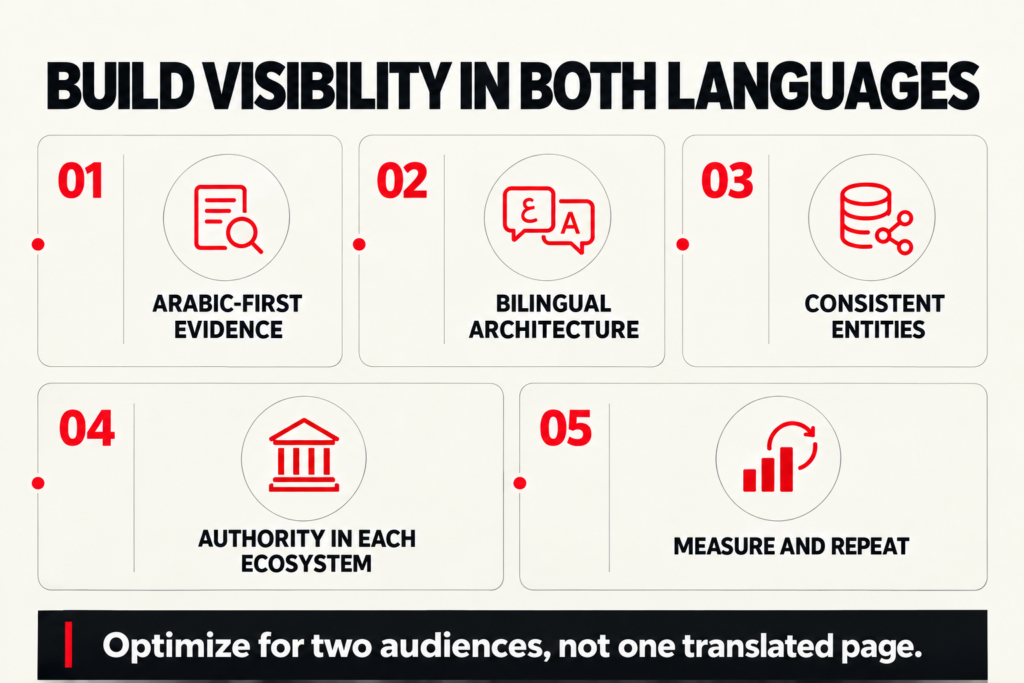
Create Arabic-first evidence
Publish original Arabic research, comparisons, expert commentary, FAQs, case evidence and locally relevant explanations. Do not use Arabic as the storage cupboard for shorter versions of English pages.
For arabic vs english ai overviews, the strongest Arabic opportunity is often information gain: provide useful regional evidence that does not already exist in thirty identical articles.
Keep bilingual pages equivalent, not identical
Both language versions should represent the same brand truth, but examples, terminology and supporting questions may differ. The English page may need global comparisons; the Arabic page may need market-specific terminology, regulations and local decision factors.
Strengthen technical language signals
Use separate, indexable URLs, correct language annotations, self-referencing canonicals and clear internal links between equivalent language pages. Ensure Google can render and index the primary content.
Our Technical SEO services address the crawlability and international architecture that both traditional rankings and AI retrieval depend on.
Build consistent Arabic entities
Standardize brand naming, author profiles, organization details, service descriptions and location relationships. Use structured data accurately where it supports Search features, but remember: there is no special “please cite me in Arabic” schema. If someone claims to sell one, ask them to show the Google documentation and perhaps their return policy.
Clear entities help arabic vs english ai overviews connect both language experiences to the same real business.
Earn authority in each ecosystem
English authority may come from international publishers, industry reports, directories and specialist communities. Arabic authority may require regional media, local associations, government references, Arabic expert contributions and original data.
Our GEO services connect on-site content, entity clarity and wider source authority across generative search—not merely traditional ranking positions.
What Not to Conclude
| Tempting conclusion | Better interpretation |
|---|---|
| Arabic AI Overviews always cite Arabic pages | They may cite Arabic, English or mixed-language sources depending on the query and evidence available. |
| English success will transfer automatically | The Arabic retrieval environment may contain different competitors, entities and source types. |
| Arabic is easier because competition is lower | Lower content volume can create opportunity, but also weaker evidence and less predictable citations. |
| Translation is enough | Translation can preserve meaning; it does not perform Arabic intent research or build local authority. |
| One test proves the pattern | A single result is an observation. Repeated matched tests create evidence. |
Good arabic vs english ai overviews strategy lives between two bad extremes: assuming both languages behave identically and inventing an entirely separate ranking mythology for Arabic.
Arabic vs English AI Overviews Checklist
- Define matched Arabic and English intent clusters.
- Test from the same MENA market under documented conditions.
- Record AI Overview presence, citations, entities and source types.
- Separate MSA, dialectal and mixed-language query patterns.
- Audit whether Arabic pages offer original local value.
- Standardize Arabic brand and entity naming.
- Verify crawling, indexing, canonicals and language annotations.
- Connect corresponding pages with useful internal links.
- Build relevant authority in both Arabic and English ecosystems.
- Repeat tests before turning observations into strategy.
- Measure leads and conversions—not citation screenshots alone.
Final Thoughts
Arabic vs english ai overviews reveal something bilingual brands should have learned from traditional SEO: language changes the competitive environment, not just the words on the page.
English Google Search can draw from a mature global ecosystem of publishers, directories, forums and brand documentation. Arabic Search may rely on a narrower mix of regional authorities, government sources, publishers and brand-owned content. That gap can reduce depth—but it also gives MENA brands a rare opportunity to publish the evidence the market is missing.
The goal is not to make every Arabic AI Overview match the English one. The goal is to ensure both audiences can find accurate, locally useful information and recognize your brand as a credible source.
At Maps of Arabia, we approach arabic vs english ai overviews through bilingual intent research, controlled citation testing, Arabic-first content, technical SEO and business-focused measurement. Explore our Arabic SEO services, Answer Engine Optimization services or GEO services if your visibility changes dramatically when the search language changes.